
Stop Using Epics & User Stories
Hey Ant here 👋 I write a newsletter that won't go viral - and that's the point.
Because hot takes, clickbait and AI slop won't help you ship better products. But practical content grounded in real work will - the kind I do every day on my own products and the product leaders I coach.
Join 15,000+ product people who subscribe. Same applies to my YouTube channel!
Recent posts you might have missed:
- The Most Demanding Role in Product
- Exploring vs Exploiting: The Two Modes of Product Discovery
- Prioritization Happens In Layers
Three quick announcements:
I just launched 4x free AI Product Coaches in beta🚀
Next live stream on Wednesday: How to actually define and find what’s valuable
Upcoming AI workshops exclusive to the Product Mentorship – more details here.
If you're stuck arguing over what's an epic vs a user story, this post is for you. It might be time to ditch them altogether.If I had a dollar for every time I heard an argument over whether something was an epic, a user story or an initiative, I wouldn’t be a millionaire but I’d probably have a hundred bucks.
More importantly, lots of time, energy and money are wasted having these arguments, and companies could save thousands.
And I’m not saying they can’t be helpful or valuable constructs. I have definitely seen places where that’s true – but more often than not I've seen it cause problems.
At the end of the day, who cares if it's an epic or an initiative? It's work that needs doing.
But where I do have a problem is when they distract us from what’s actually valuable; outcomes, customer problems, opportunities, experiments, etc.
Why dress up an outcome as an initiative, or an opportunity as an epic? You might as well just call ‘a spade a spade’.
Organisational Clarity
One of my favourite leadership books is Turn the Ship Around by L. David Marquet. I consider it a bit of a bible for empowering leadership.
One conclusion Marquet landed on was that empowerment (giving control) is dangerous without 2 things:
Competence: You possess the technical excellence, skills, and knowledge required to make safe, intelligent, and effective decisions.
Clarity: You understand the organisation's purpose, goals, and strategic intent, ensuring your decisions naturally align with the mission.
One problem with arbitrary terms like epics and user stories is that they reduce number 2. Clarity.
It’s therefore no surprise that you see teams caught in these long-winded arguments over what an ‘epic’ is.
It’s not like I’m anti-agile or anything. It’s about clarity and putting energy into what is actually important.
Put your energy into what actually matters
Instead of arguing over what’s an epic vs user story, I’d rather you put my energy into defining:
What are we trying to achieve?
What problem are we solving, and for who?
What's the smallest thing we can do to get closer to that outcome?
And whilst you can absolutely still do this with epics and user stories, I’ve found there are better tools to facilitate this thinking.
This is why when I work with teams, more often than not, I move them away from epics and user stories and towards one-pagers, opportunities and hypotheses.
From:
Initiatives → Epics → User Stories
To common words everyone understands:
Outcomes → Opportunities → Experiments
And maybe you’re looking at this like Pam from The Office wondering what’s different.
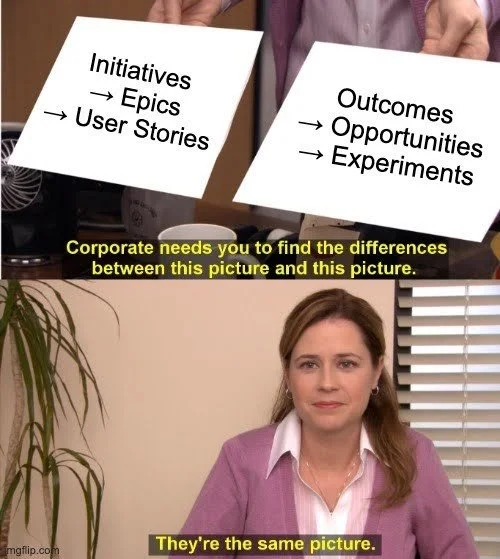
But I can tell you from experience that if you asked several teams what a User Story is, I doubt they’ll answer an experiment – nor will they say Epics are Opportunities.
Compare the typical user story narrative to a hypothesis statement:
A user story articulates the who, what and why:
As a [type of user] I want to [goal] so that [reason].
A hypothesis articulates the same — but adds uncertainty and a measure:
We believe that [doing something] for [type of user] will achieve [some outcome]. We'll know we've succeeded when we see [this measurable impact].
Going from "I want" to "we believe" shifts from an output to an experiment.
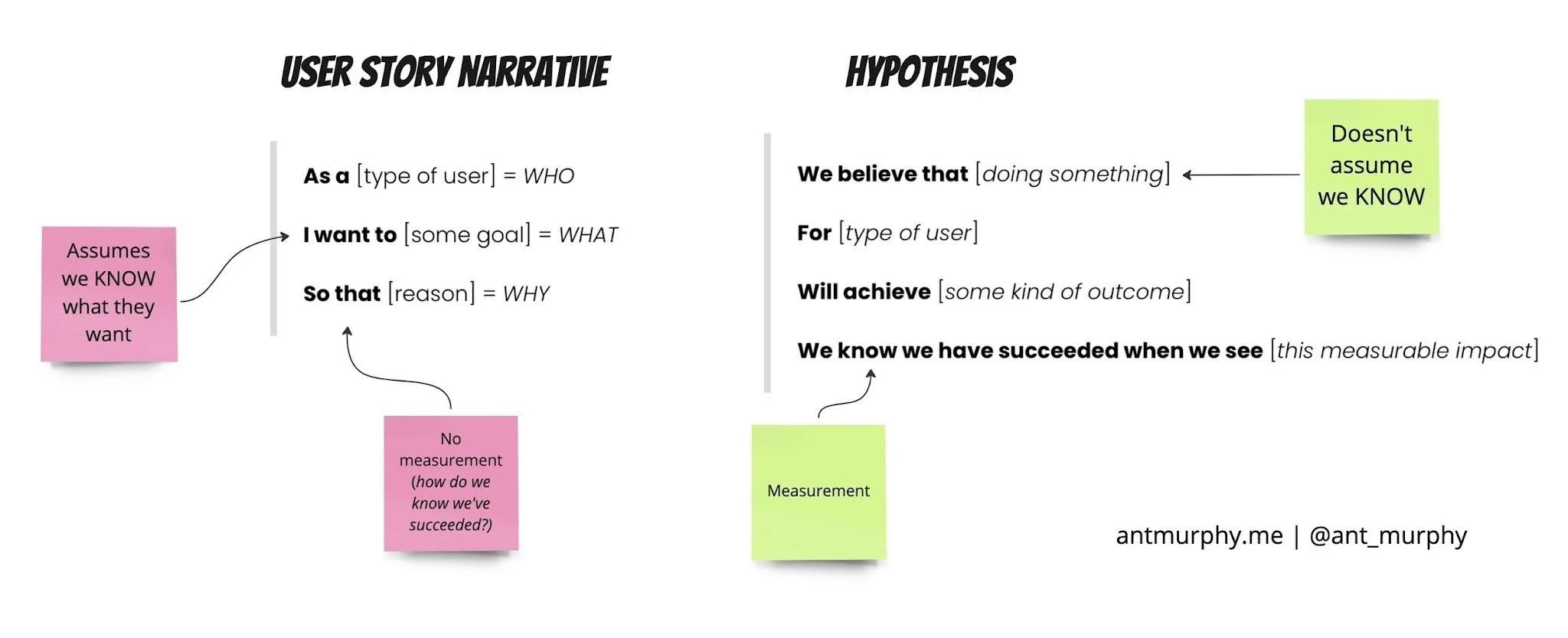
User Story Narrative vs Hypothesis Statement
But this does bring up an important point: If Initiatives → Epics → User Stories is working for you, DON’T change it!
This post isn’t for you. It’s for those who are wasting more energy debating terms than actually getting work done.
Change how you work, not how you think
You could argue that none of this matters. It’s just semantics – and there’s some truth to that. But when you're trying to drive the kind of change a lot of leaders and transformations are after, how we work matters
We like to think it doesn’t. We quote constantly that it’s all about mindset. But how do you change your mindset?
John Shook, wrote an award-winning article for MIT Sloan Management Review called "How to Change a Culture: Lessons from NUMMI".
In the article, Shook shared his experience at NUMMI (New United Motor Manufacturing Inc., a joint venture between Toyota and GM) where he discovered something counter to what conventional wisdom would suggest.
Conventional wisdom would have you think that change starts with people’s mindsets. That once we change our mindset, then the new desired behaviours will follow.
But that was not what Shook experienced at NUMMI. Instead, he stated:
"What my NUMMI experience taught me that was so powerful was that the way to change culture is not to first change how people think, but instead to start by changing how people behave — what they do...The culture will change as a result."
Culture change starts not with mindsets but with behaving differently.
By changing the way we behave, we experience the benefits of working in a different way.
First hand experience is far more convincing to change one's beliefs than any lecture or case study can achieve. After all, ‘seeing is believing’.
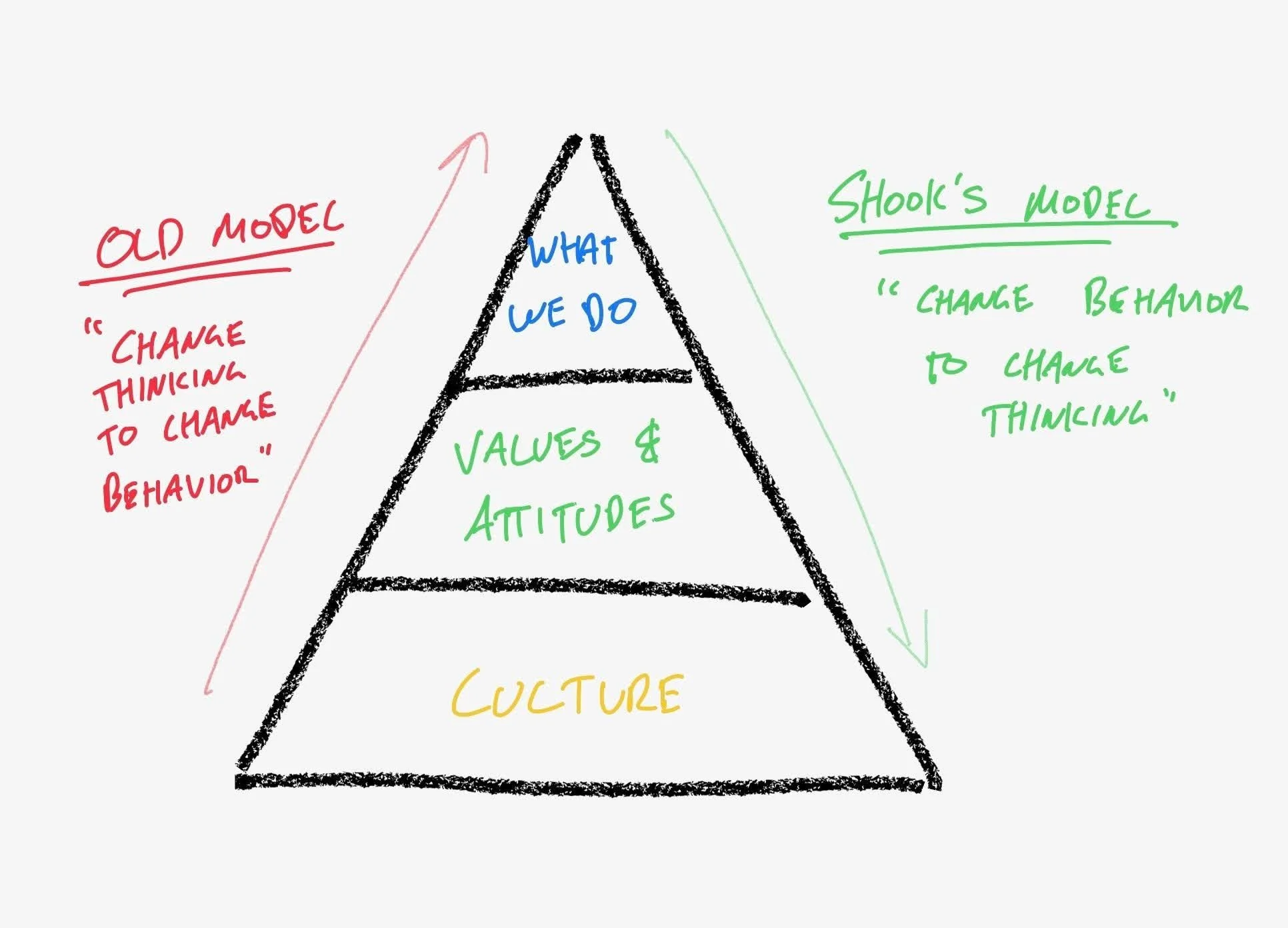
Traditional thinking (change thinking to change behaviour) vs Shooks model (change behaviour to change thinking)
So yes, this is semantics but the semantics matter!
How we work, the tools we use, their framings, how they facilitate our thinking – and more importantly the actions they make us take is how you change culture and mindsets.
So if you want to be more outcome oriented, you need to first start acting that way.
Which means speaking to outcomes, opportunities, experiments, assumptions, etc.
And as someone who has successfully done exactly this at several companies now, it’s not theoretical.
I’ll leave it there today.
I hope this helps one of you. Perhaps it was the nudge you needed.
If you know someone stuck on a perpetual hamster wheel arguing over what an epic is, send this their way – they could do with the nudge also.
And as usual, any questions send them my way.
Thanks as always!
Ant
p.s.
→ Check out the AI product coaches.
→ Free Product Strategy templates and real world examples.
→ Upcoming AI workshops for Product Mentorship members only.
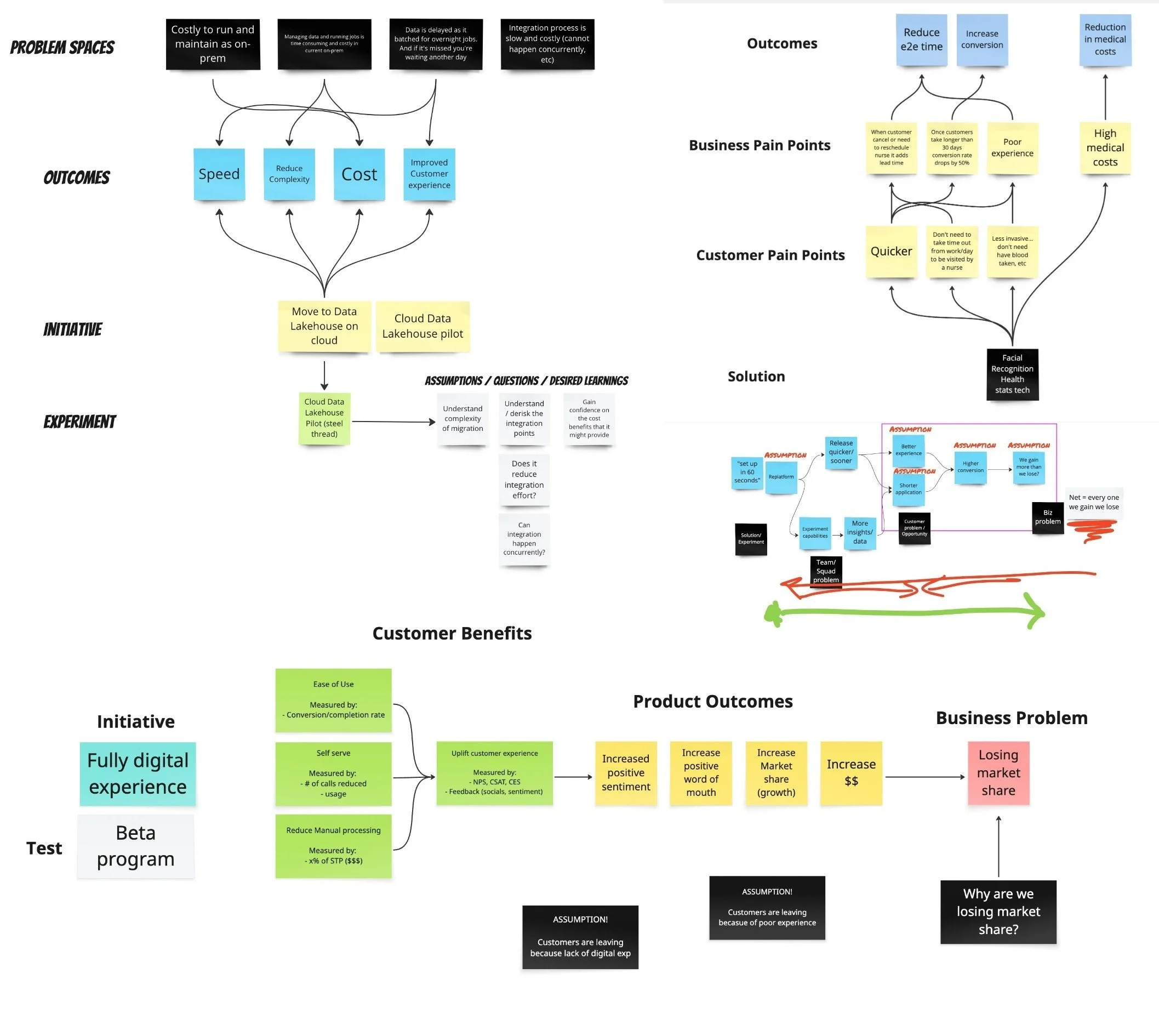







Your OKRs don’t live in a vacuum.
Yet this is exactly how I see many organizations treat their OKRs.
They jump on the bandwagon and create OKRs void of any context.
Here’s what I see all the time…