
How Product is Changing in 2026
What Product Managers should double down on, drop and learn in 2026. Based on actual data.
Hey Ant here, I started this newsletter to share the lessons I wish someone had told me 10+ years ago early in my product career. Expect to find practical lessons on building products, business and leadership. If you prefer podcasts or videos, check out my YouTube.
Recent posts you might have missed:
- The Hardest Part of Product Management is NOT Features, it's People.
- 5 Steps From Features to Outcome Roadmap
- Don’t Follow Frameworks. Break them.
As this is the last post for 2025, I wanted to say thank you.
Thank you for reading, replying, and supporting this newsletter. It honestly means a lot.
I try not to let any of you become a “subscriber count” to me. It’s why I always say reach out any time (I mean it!) To those who did, thank you, I enjoyed every conversation.
If it were possible, I’d absolutely love to grab a tea, coffee, beer, wine, chai latte - or whatever your drink of choice is - with each of you. If you ever see me at a conference or something, come say hi!
Here’s what you helped make happen in 2025:
Launch the Product Mentorship. Which has…
Helped 7 Senior PMs land a new role through the Product Mentorship
Run 73 private events for the Product Mentorship
35+ members (largely senior to head of product level)
695 engaged hours in the mentorship community
345 comments & 179 community posts (that’s people getting help!)
Product Discovery course 🚀 with 62 PMs improving their ability to uncover meaningful opportunities
8x flights 🛬
300+ cups of coffee
10x free webinars with 4,000+ views on the recordings
74x coffee catchups (mix of actual coffee and virtual)
73x 1-on-1 coaching sessions
6x group coaching sessions (not including the product mentorship)
4602 new followers on Linkedin (apparently)
1k new subscribers on Youtube
One happy Ant and family 😉
Thank you!
I could have opened this post with “product management is dead” or “if you’re not an AI PM in 2026 you’ll be left behind.”
Ahhh. Fear!

But whilst those takes get attention, they’re rarely grounded in fact.
And I don’t need to tell you this, as the amazing product people you are, you know well that we should always seek truth over nice sounding narratives.
Which is why I spent several days doing my own research, going through different reports and looking at data to understand what’s actually happening in product (sources at the end).
This is something I do every year as part of revisiting my strategy.
Last week, I decided to walk through it all live in this live stream.
I’m not going to cover everything from the steam here. Instead I’ll focus on the key takeaways.
Specifically:
The 4 big trends reshaping product right now
The top skills for product managers in 2026
What you should double down on
All actionable and grounded in real data.
It’s not a trend report or hot take. I’d argue it’s the opposite.
As you’ll see in the first data point, product is far from dead. It’s actually growing!
So if anything consider this your anti-hot take (cold take?)
4 BIG Trends Reshaping Product in 2026
1. Job Market Rebound
If you feel like the market has crashed, you aren't entirely wrong. But zooming out tells a different story.
Lockdowns and covid drove a tech bubble which eventually popped in 2024.
It’s easy to spin a story that recent layoffs are driven by AI, and whilst I’m sure some of them are, if you zoom out you’ll see we’ve had a boom followed by a sharp correction.
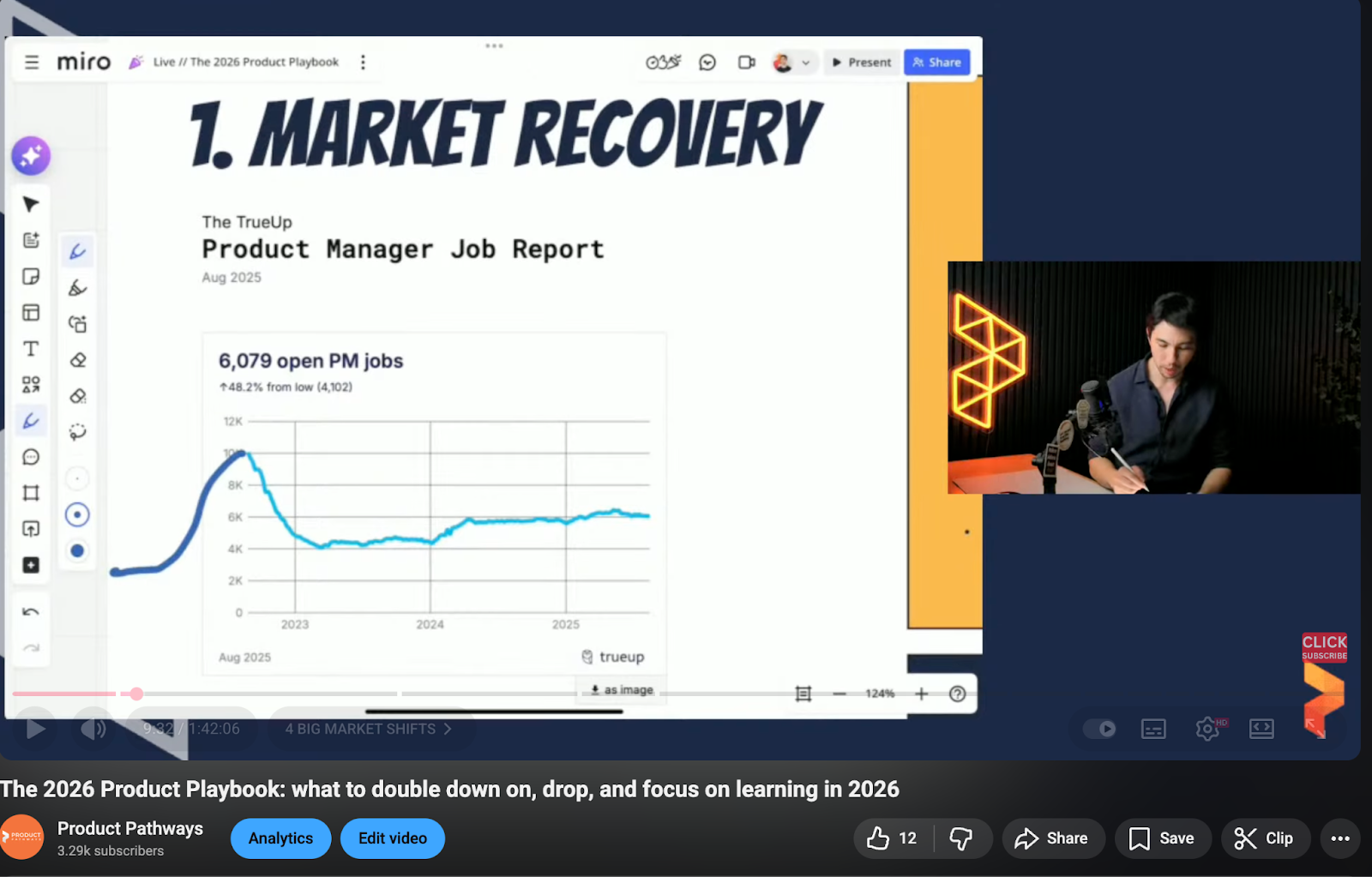
Which means if you were to remove that bubble, the chart would look more linear. Indicating that a lot is probably due to overhiring more than anything.
Today there’s approximately 42,000 open Product Manager roles on LinkedIn, double what was reported this time last year. Indicating the market is well into recovery and more aligned to what we saw pre-2020.
There are also more people in product today than pre-2020. Roughly 2.5 million people have the title ‘Product Manager’ on Linkedin.
So whilst we feel the aftershocks of the bubble bursting, the market is actually in good shape and product management is far from dead. In fact it’s growing!
1a. AI PM roles
Of course if we’re talking about roles, we have to talk about AI Product Management.
Currently AI PM roles account for approximately 8-10% of all open product management roles with nearly half of those positions based in the US.
It's important to note this count represents new jobs, not the total number of roles in the market.
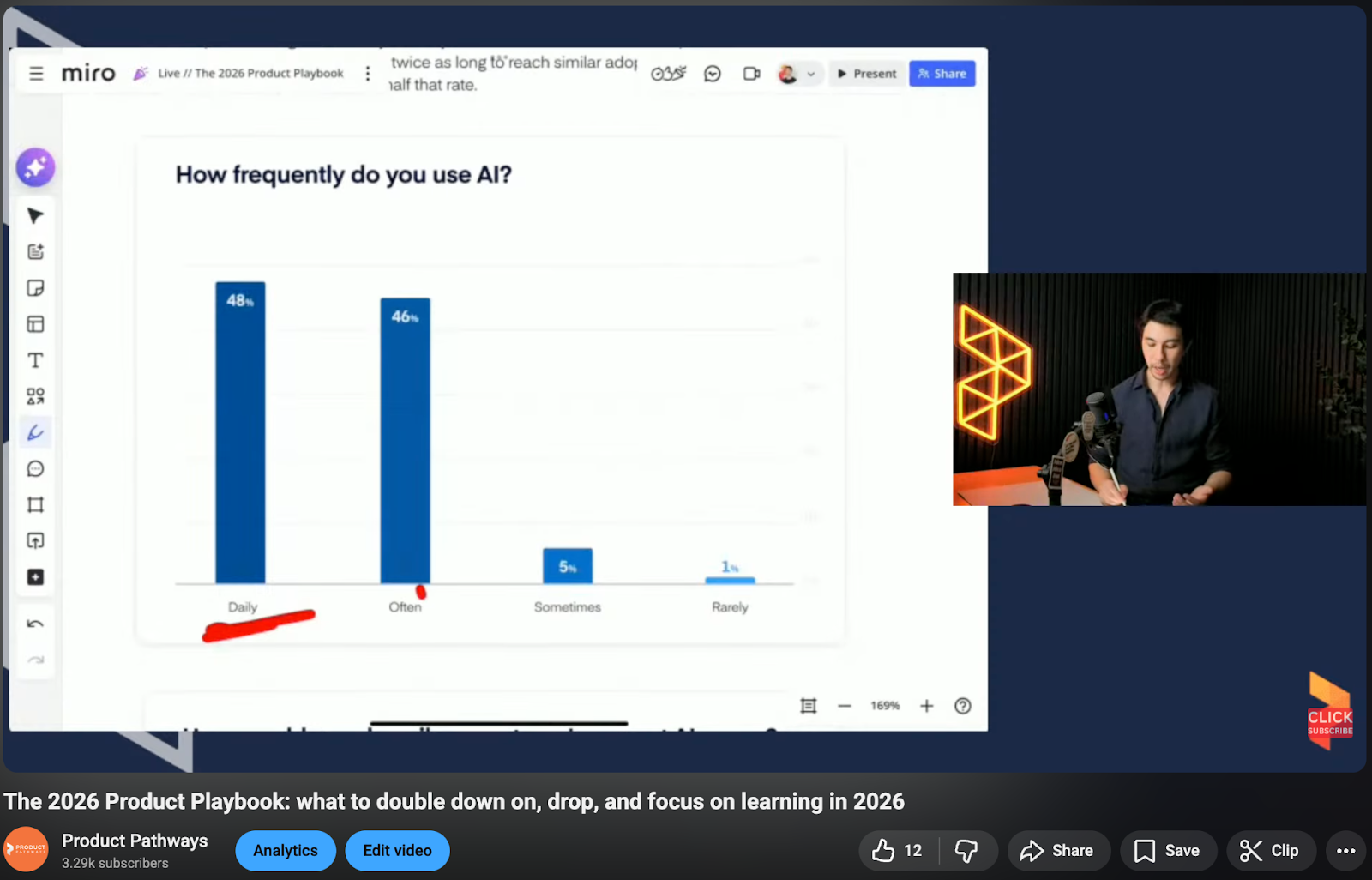
I think it’s early days to draw any firm conclusions on this specific role but as you’ll see in the data later on, 96% of PMs (regardless of their title) use AI on a frequent basis. So title aside, using AI to build products is definitely becoming the norm - I know it has for me (afterall AI helped me pull this data!).
2. Profits over Growth
Product doesn’t operate in a vacuum.
Whilst we solve user problems, we need to also do it in a way that it works for the business.
This means finding user problems that help us achieve the business goals - and this is where we saw a major shift.
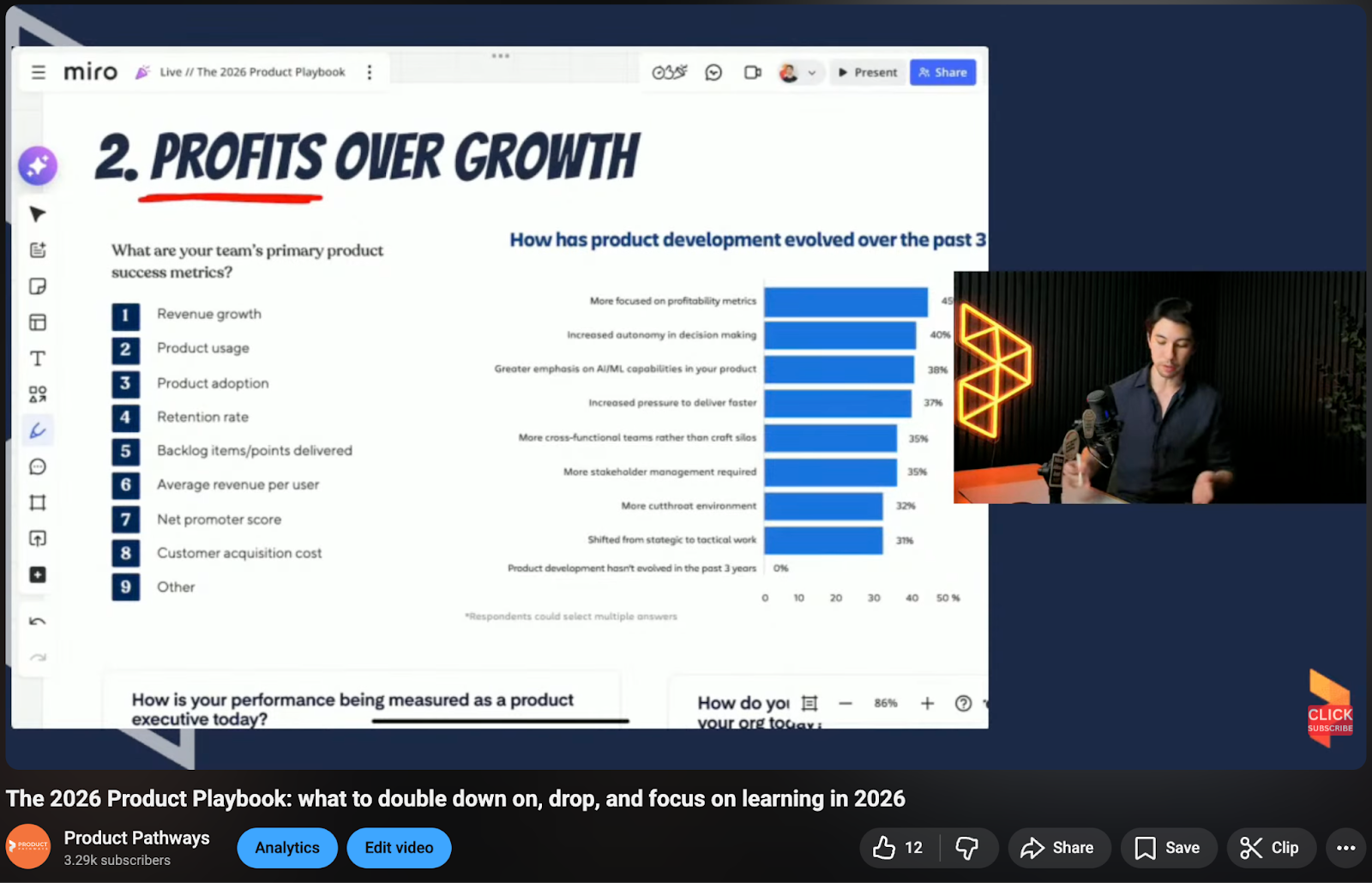
Companies shifted towards revenue and profit targets over growth goals, like adoptions, acquisition, usage, etc.
This was one of my predictions from last year as I could see the macro economics shifting towards uncertainty and less liquidity.
And the data showed this.
ProductPlan's 2025 Report showed revenue growth as the number 1 success metric for product teams.
Productboard’s CPO Survey had a similar finding, with revenue and profitability as the top metrics product executives are using to define product success and report to the board.
2a. Product losing a seat at the table
This macroeconomic shift has had a direct side effect leading to a reduction in empowerment for product.
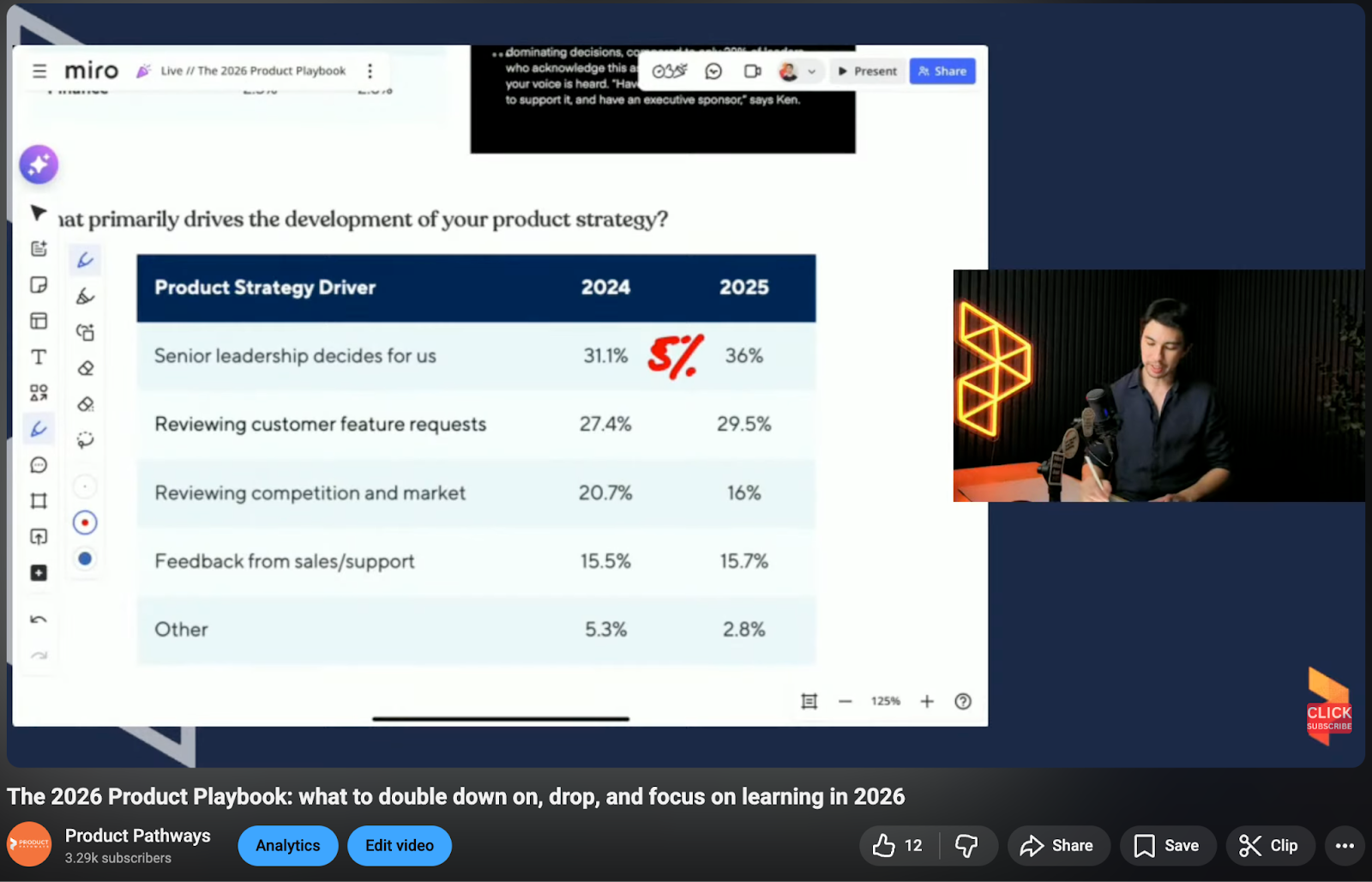
ProductPlan’s report showed a 5% increase in senior leadership deciding product strategy as compared to last year and saw an increase in output measures such as ‘tracking the number of items completed on a roadmap’ as a key measure of success.
Productboard’s CPO Survey also showed increases in senior leadership deciding the product strategy and strategy influences shifting away from external market trends to internal directives.
And I’ve been seeing this with my clients and almost everyone in the Product Mentorship.
There’s been a real shift towards delivery and top down direction this year.
So if you feel like you’re being handed down roadmaps this year, it's not you. Everyone seems to be in a similar position.
3. AI Wins & Challenges
The AI data was interesting.
As mentioned before, regardless of the title, AI powered product development is happening.
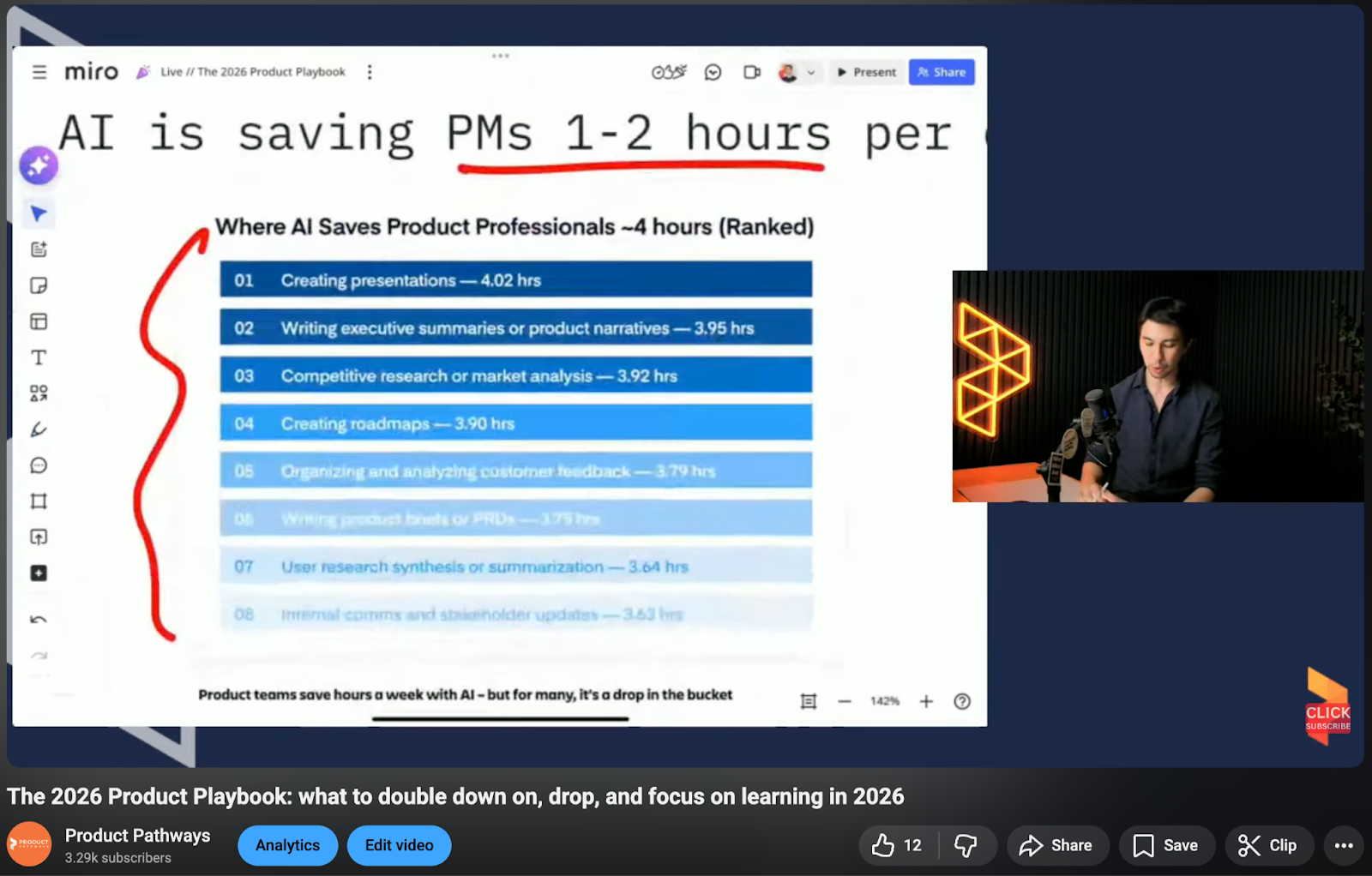
Productboard’s AI Survey highlighted 94% of product professionals use AI frequently, and nearly half have it deeply embedded into their workflows.
In terms of outcomes, it’s largely internal productivity with reports that AI are saving PMs about 1-2 hours per day.
However, outside of productivity the outcomes are less promising.
MIT (Massachusetts Institute of Technology) found that 95% of enterprise generative AI pilots fail to provide a measurable return on investment (ROI) or impact on profit and loss. With similar reports coming from Productboard and Atlassian’s research too.
I also saw this with my clients, AI's speed can be deceptive. You can build a lot in 4 days, but it may take you months of evals and fine-tuning to bring it to the market.
4. Role Blurring
Product team structures are entering a period of experimentation.
The traditional 1:8 ratio of PMs to engineers is shifting.
As LinkedIn’s CPO, Tomer Cohen, shared on Lenny’s Podcast Linkedin have replaced their APM (Associate Product Manager) program with a "Product Builder" program that trains generalists across product, design, and engineering.
However I think it’s still early days here. Companies like Linkedin are experimenting, time will tell what works vs what doesn’t.
What this does mean however is that I see collaboration as a skill being more important than ever. The more the lines blur, the stronger collaboration needs to be to avoid friction.
What Are The Top Product Management Skills for 2026?
Productboard’s AI report showed the following as top product skills becoming increasingly important in 2026:
Data literacy
Synthesizing customer insights
System-level thinking
Strategic thinking
AI/ML knowledge
Rapid experimentation
Technical fluency
Communicating ideas effectively
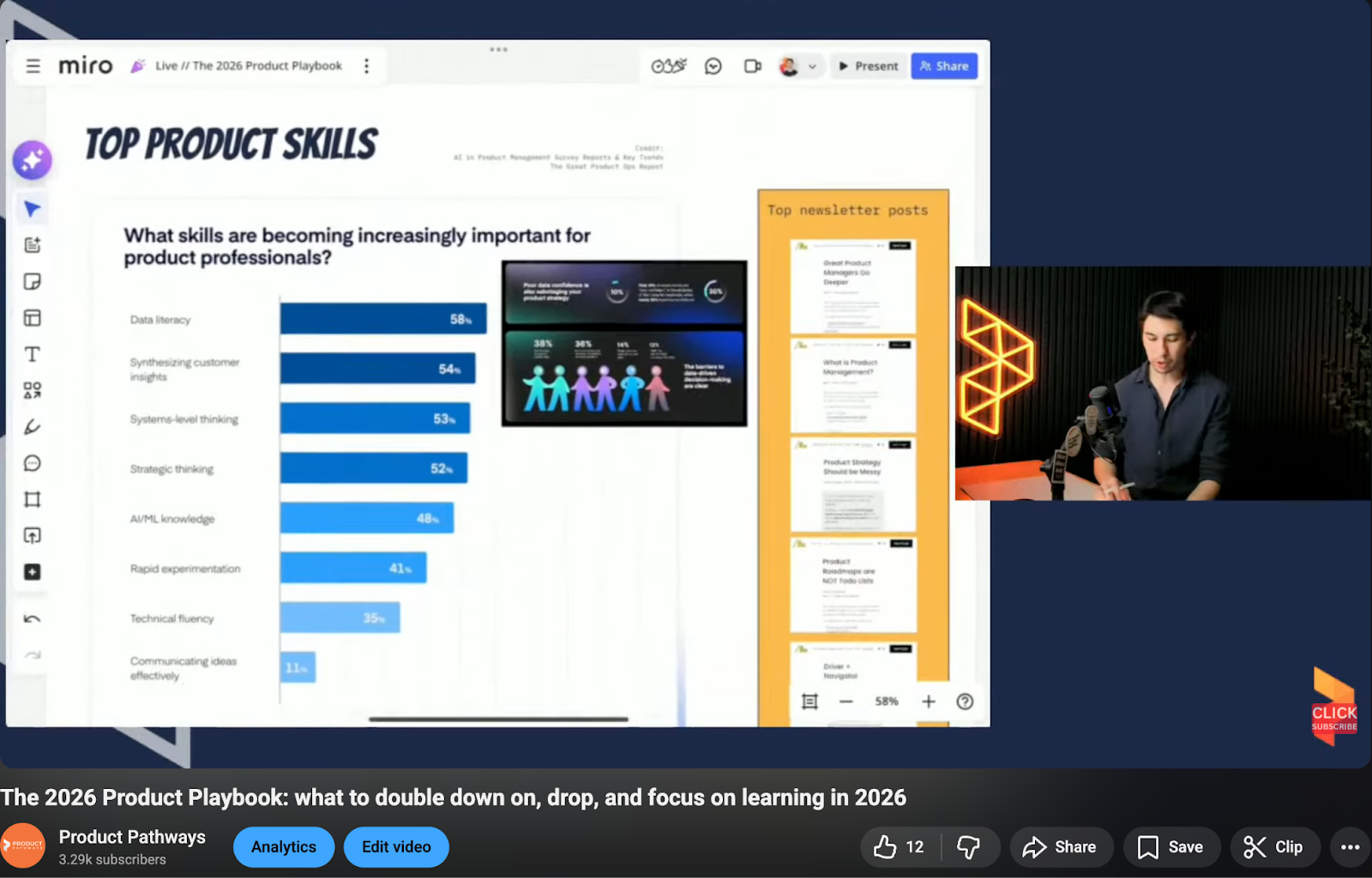
Going deeper, the same survey reported 59% believe strategy and business acumen were the most important skills for PMs in the next 2-3 years.
Other reports also put strategic thinking and business acumen as top skills for 2026 and if you consider the trends mentioned at the start, the increased focus on business impact, like revenue and profitability would reinforce this.
So after triangulating several reports as well as the trends mentioned before. The top skills for product managers in 2026 are:
Product Strategy
Business acumen
System-level thinking
Data literacy
AI and Machine Learning
Collaboration
Influence
I mentioned collaboration earlier as an increasingly important skill as roles blur but I’ve also added influence too due to increase in top down decision making.
FYI if you’re interested in levelling up any of these skills, I have a bunch of free content on youtube and in past newsletter posts.
But if you’re looking for more help consider joining the Product Mentorship. Expect several workshops and specific content targeting these skills in 2026.
It’s a great way to set 2026 up for success. But you don’t take my word for it, here’s what a current member said today 👇
“Joining this mentorship has been invaluable for me, especially as someone new into product.
Any time I’ve had questions they’ve always been answered with professionalism, depth and clarity.
The content has always been insightful and engaging. (Unlike like the generic information online)
Sooooo glad I found Product Pathways.”
What to Double Down On in 2026
Based on all these data points here are the 5 things I am doubling down on as a product leader in 2026.
1. Product Strategy
Strategic thinking has always been a key skill for product managers but as AI takes away the grunt work and administrative tasks, the emphasis on skills like product strategy increases.
As one Head of Product put it in Productboard’s CPO Survey,
"Speed without direction is just chaos in disguise”
And this is more important than every with AI increasing the speed part every day.
In a world where anyone can quickly ship an AI-generated product, taste and strategic foresight will matter more than ever.
If you’re new to product strategy and don’t know where to start, I recommend the free section of the Product Strategy course. You don’t need to pay for the full course, the free section explains what product strategy is and includes a few templates and examples to get you started.
2. Contextualising Value and Impact
You might remember at the start we’re seeing more top down direction, so I don’t blame you if you’re wondering why bother with strategy if that’s being taken away from product?
Well there’s a problem. It’s not working.
Atlassian reported that 84% of product teams are currently concerned that what they’re building won’t be successful in the market and Productboard found that nearly 39% of product investments are failing because of a lack of clear company strategy, up from only 25% in the previous year.
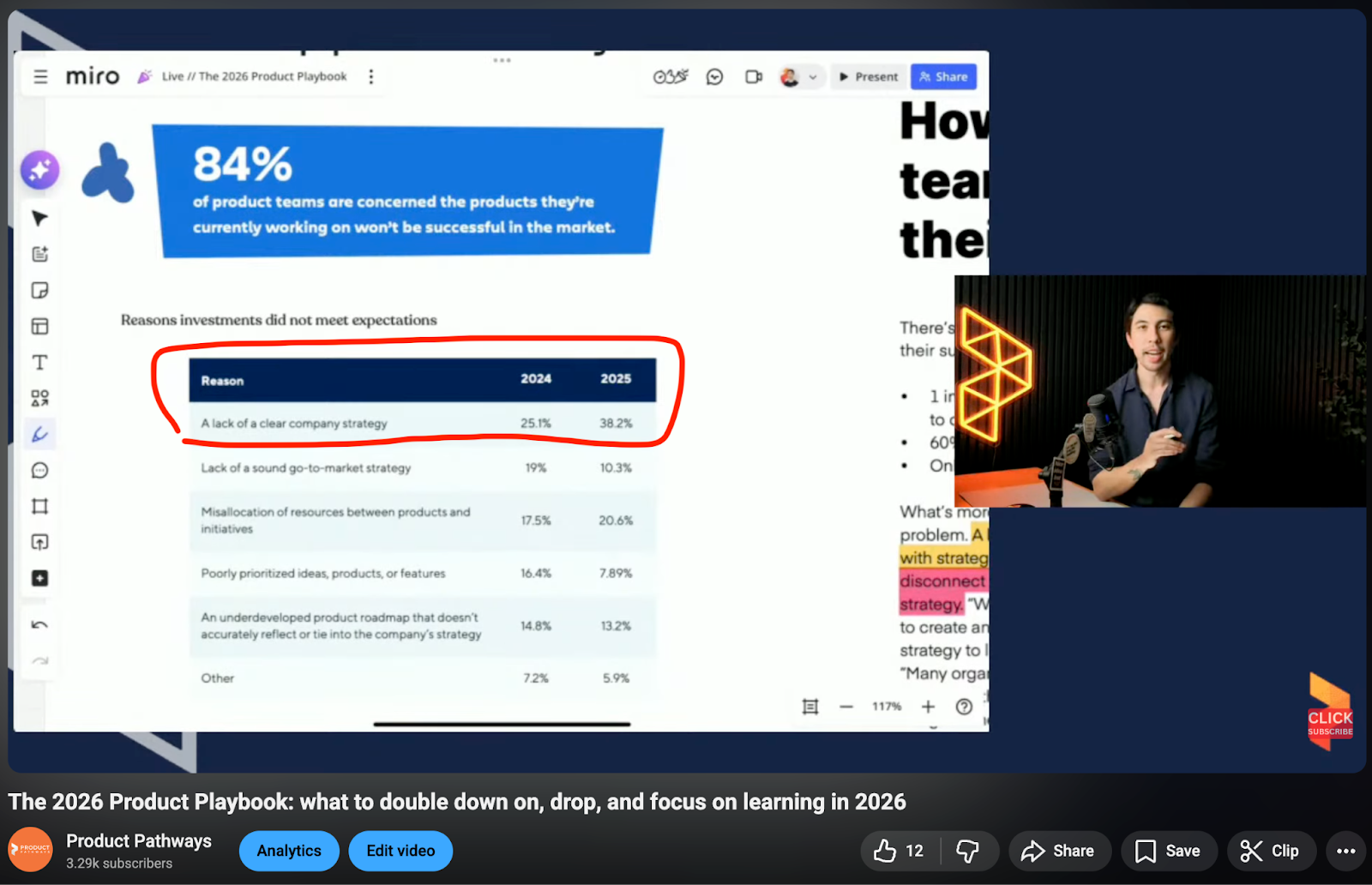
Therefore, strategy and more specifically, the ability to break down high level business goals like “increasing revenue” to specific product outcome that drive the higher level outcome is an important skill.
I would argue this is THE MOST IMPORTANT skill for 2026 given the data above.
As Atlassian’s State of Product Report framed it: the role is evolving from "owner of the roadmap" to "architect of impact".
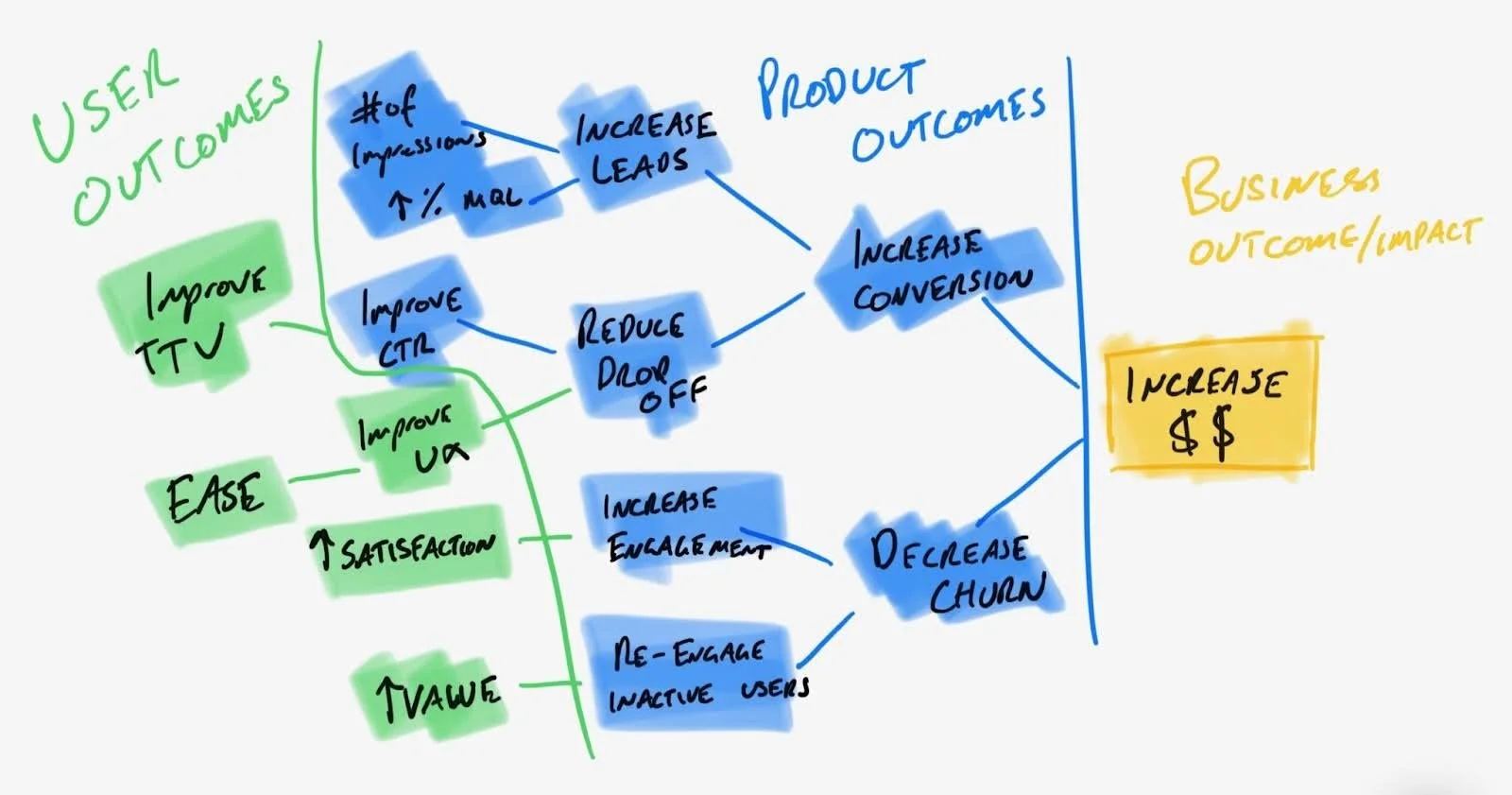
Example KPI tree breaking down business outcome "Increase revenue" down into different drivers.
More on this skill in this video.
I also interviewed Steve Klein, the CPO and co-founder of Vistaly where we walked through a real world example of this in practice here.
3. Influence
Improving your influence will serve you well no matter the year or role you’re in, so I won’t go deep into this, instead I want to specifically call out two key things for product managers:
The ability to connect the dots, as mentioned above
and business acumen
In a world that’s increasingly heading towards internal influences and business goals such as revenue and profits. Being able to speak their language is going to get you far.
Here’s a litmus test;
Can you explain how your company makes money (assuming it’s profit driven)?
How does your product contribute?
Can you measure that contribution?
If you can’t answer any of those questions, that would be something I’d put at the top of my todo list for January 2026.
FYI if you want somewhere to start in terms of building your influence. The previous newsletter post is a great place. In it I share 5 different influencing tactics that I use regularly. Highly practical stuff you can use tomorrow.
4. Optionality
As I replied to a comment this morning, the optimist in me would like to believe all this focus on efficiency is a deliberate strategy and not because they want faster feature factories.
Here’s what I hope they’re doing instead.
When uncertainty is high, you typically don’t want to box yourself into a corner. Instead you want to keep your options open.
It’s probably the one and only time where it’s ok to spread your bets and not be laser focused.
There are many ways you can do this, one is speed.
I prefer speed because rather than doing multiple things, you still remain focused but you keep your options open through your ability to quickly pivot.
If you can pivot quickly, you will always have optionality because if something new pops up you can capitalize on it.
One of my clients is doing exactly this. They’re a slow traditional enterprise and AI has been a sober reminder to them that they’re not set up to capture new opportunities.
As a result they’re intentionally doing a lot of work to remove barriers and speed product development up - so much so that they’ve created new teams that will be unshackled by the current red-tape and can be first responders.
Now this might not be a problem for you, but if it is, I’d seriously consider how you’re keeping your options open and ability to respond given the heightened uncertainty.
5. Talent Gap
There seems to be a talent gap forming. Similar to what we saw with mobile and the internet before that.
There’s always an imbalance between demand and capabilities when new technology comes on the scene.
Now the obvious gap will be AI skills. Productboard’s CPO Survey found that while 85% of leaders are investing in AI tools, only 2% are prioritizing talent development - a big gap!
But it’s not just AI.
I’d extend this to key skills like business acumen, product strategy and collaboration.
I’m already seeing this with some of my clients. They’re intentionally choosing to move more “up market” hiring more product leaders as individual contributors because the skill mix has shifted. They need strong product managers who can drive strategy and work closely with senior business leaders.
And collaboration will grow too. As roles blur, those who aren’t great team players will cause friction. Product leaders will be faced with choosing between their skills and the negative impact caused by their poor collaboration skills.
Wrap Up
A lot of this shouldn’t be a surprise and it’s not fundamentally different to what you should be doing anyways as a product manager.
And I think that’s an important point.
It shows that whilst there’s a lot of uncertainty and hot takes, the first principles of product management remain.
As a PM at one of my clients said to me earlier in the year;
“I thought AI was going to replace product managers but what’s actually happened in practice is we’re more important than ever. We actually need more PMs! I can see us moving towards a 1:1 ratio between PM and Engineer.”
I’ll leave it on that food-for-thought.
I can’t say it enough, thanks again for all the support this year!
Here’s a quick look back at what resonated with you all 👇
Top Newsletter Posts for 2025
Top Youtube Videos
References
Data from:
Linkedin Jobs
Indeed job postings
Product Leadership Trends & Strategic Insights (CPO Survey), Productboard (2025)
Top Posts







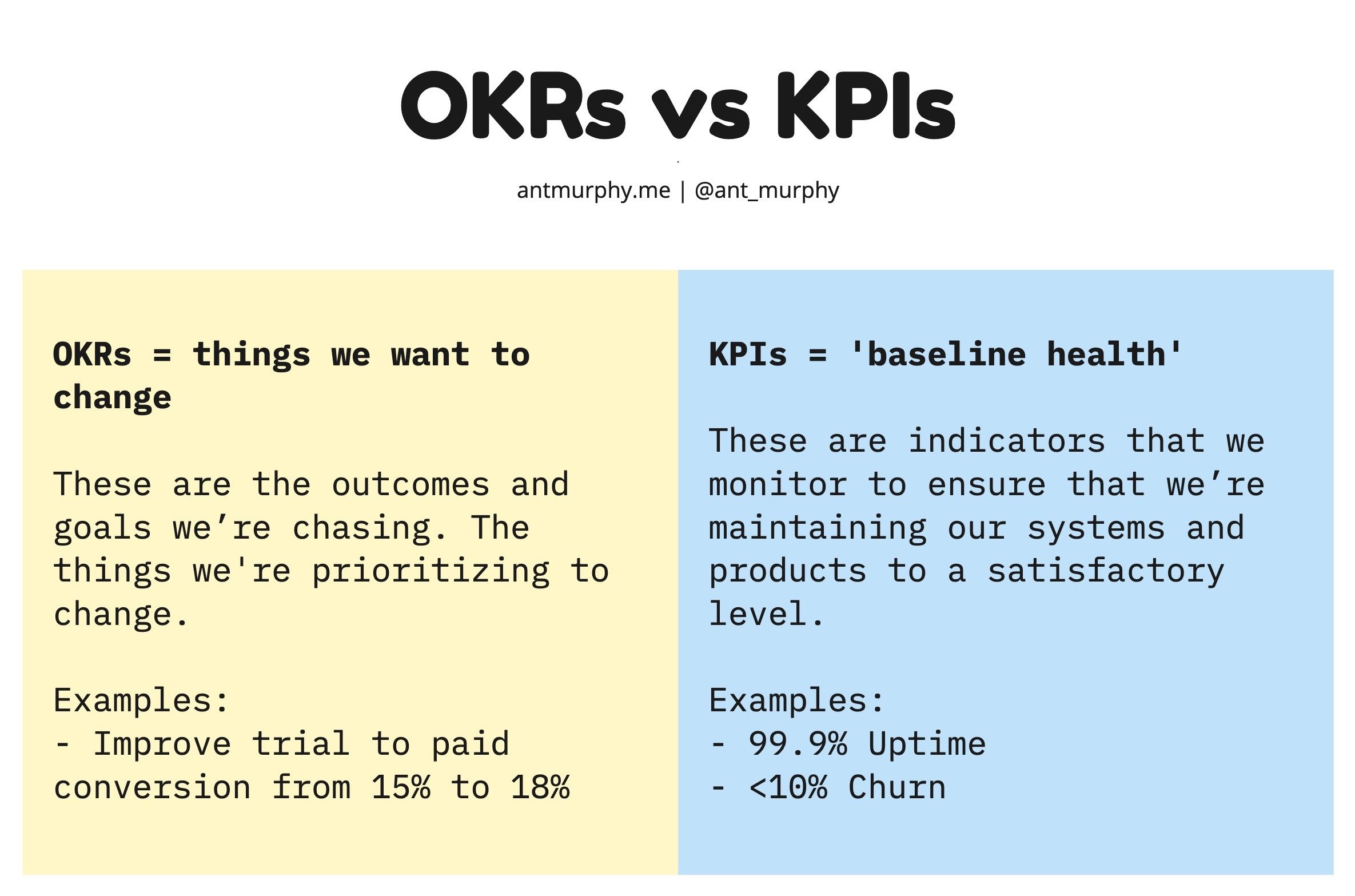

Your OKRs don’t live in a vacuum.
Yet this is exactly how I see many organizations treat their OKRs.
They jump on the bandwagon and create OKRs void of any context.
Here’s what I see all the time…