
The AI Chasm
Hey Ant here, I started this newsletter to share the lessons I wish someone had told me 10+ years ago early in my product career. Expect to find practical lessons on building products, business and leadership. If you prefer podcasts or videos, check out my YouTube.
Recent posts you might have missed:
- Improve Your Influence (not clickbait, this truly did for me)
- You Don’t Need Another Prioritization Framework: Just These 4 Components
- Free Annual Planning Workshop Template
AI moves fast. Humans Don’t
Every week I see another LinkedIn post about how AI is going to transform everything. Another “X is dead” announcement and someone shipping their latest vibe coded project.
And don’t get me wrong. I get it. The hype is real.
My head isn’t buried in the sand. It doesn’t have the same Amazon Alexa and NFT vibes. This is more like the internet or mobile phones for sure.
But think about how long both of those took to take off?
Remember it’s 2026 and there’s still companies trying to “digitize” and move off paper.
Yes. It’s hard to believe but it’s true.
And this is what I want to talk about.
I want to give you a different perspective to the AI rhetoric.
A more balanced view that you might disagree with - claiming “but this time it’s different’ - or agree with.
Either way I want to hopefully give you a different perspective on everything that is happening right now. One that’s based in research and what’s historically happened before.
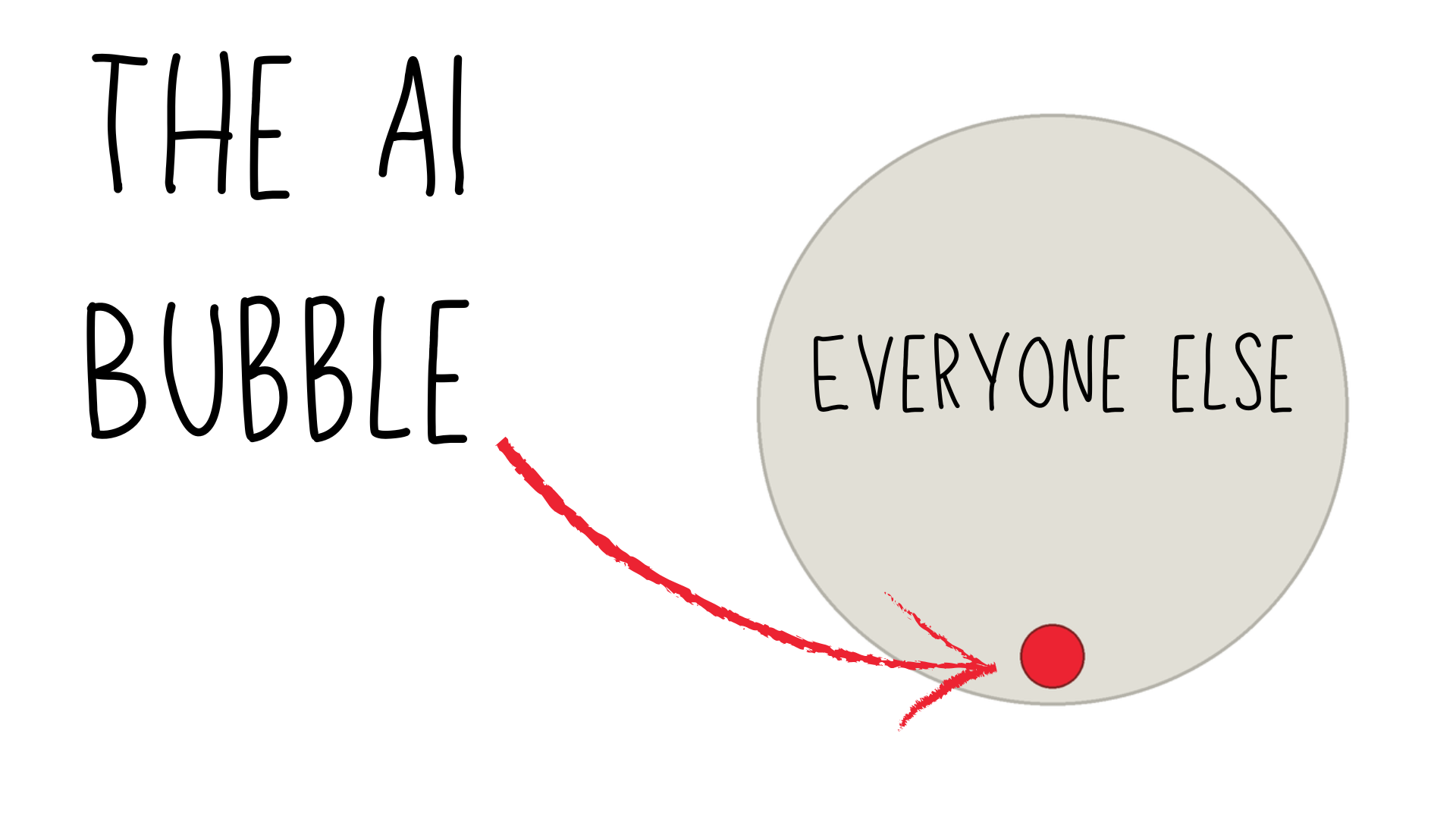
The (tiny) AI Bubble
Microsoft's AI Diffusion Report found that generative AI adoption had reached about 16% of the world's population at the end of 2025 and more recent reports from Standford’s 2026 AI Index Report show that’s ballooned to half the population.
And whilst those numbers are massive, the vast majority of users are free chat based users.
Either the nearly 1 billion ChatGPT users on their free tier or those using Gemini or through Google’s AI search.
So despite these massive numbers there’s a lot of nuance behind it. Because AI adoption isn’t just using Google AI when googling something.
McKinsey reports that 88% of organisations say they "use AI" but only about 1% have mature AI deployments delivering real value.
And that’s the chasm.
There’s a lot of AI usage through free AI-chat but few have gone beyond this.
The rest of AI usage has been following a familiar curve.
Side note: I think chat has buckled the trend and been adopted fast because of a few advantages:
It’s familiar. We’re used to google searching and sending messages. Heck we’ve probably even had to face off against a few terrible chat bots before.
It’s easy. The learning curve is little to none.
It’s free!
And perhaps the biggest boost has come from it being integrated into almost everything that we already use today. Think about Google AI Search.
So the top line number might be large but more advanced AI adoption still has a long way to go.
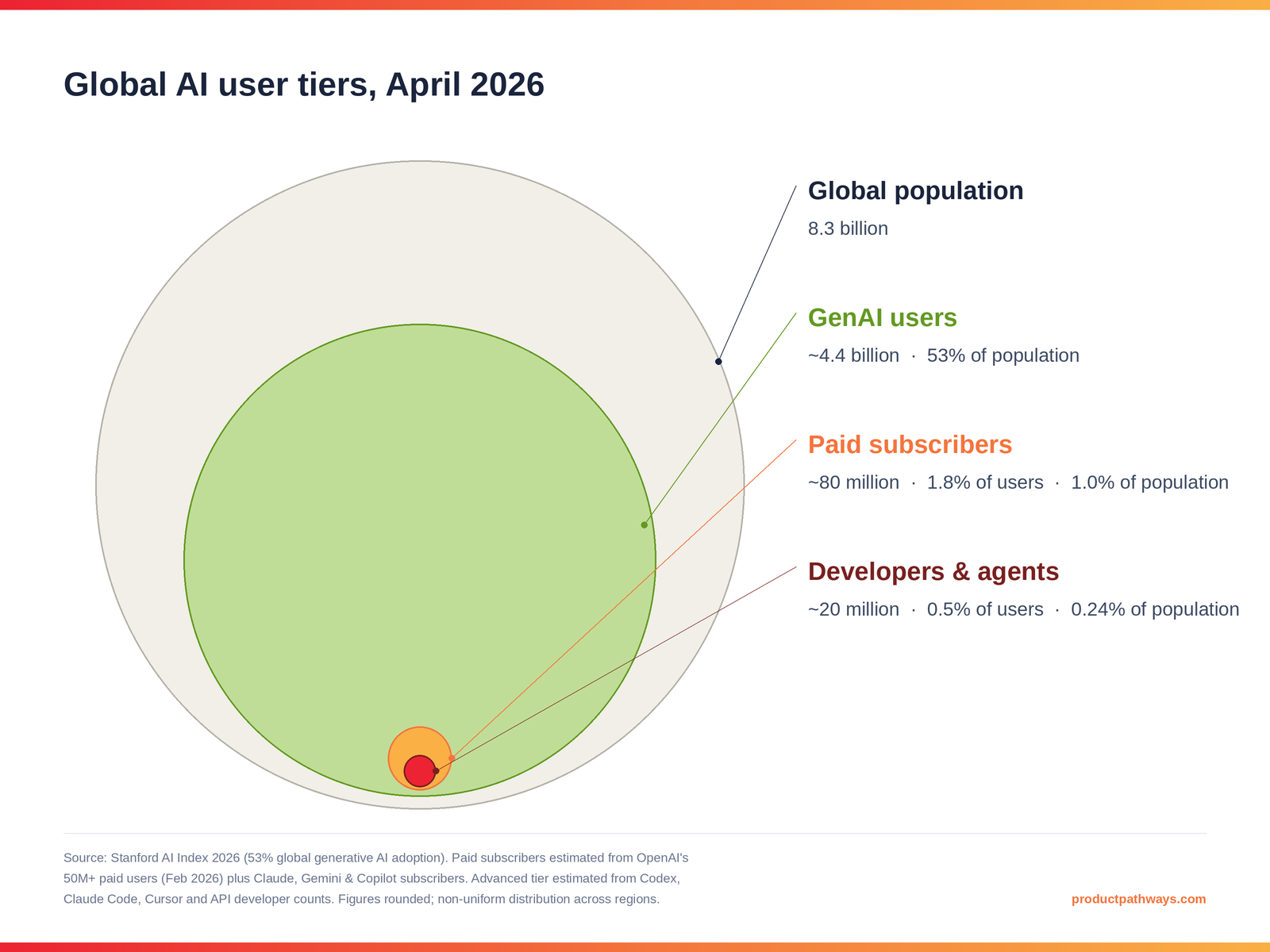
This aligns to what I’m seeing across my clients.
For those who don’t know I’m a product coach. I work with companies around the world and I also run a Product Mentorship. Because of that, I get the privilege of having a very broad and in some cases a really deep view of how companies (and product managers) are using AI around the world (or not using it).
What I’m seeing is just about everyone across both the product mentorship and all my clients are doing something with AI.
But it ranges from asking ChatGPT questions to AI agents.
And as you might assume, the spread looks very similar to the stats above. A very small number have Claude Code running the product development lifecycle. The majority are business as usual with a little AI sprinkled in.
For example, a recent terms for a potential client had AI restrictions in it… and yes the irony isn’t missed that I had AI point this out for me.

Now this isn’t permission to bury your head in the sand.
But you’re not behind. Adoption will take longer than you might think.
We've Seen This Before
What we’re seeing is the same adoption curve that every major technology before has followed.
Everett Rogers laid this out in Diffusion of Innovations back in 1962 and it’s still as true today as it was back then.
This is because it’s based on human behavior and whilst tech has changed significantly - humans haven’t evolved at the same speed.
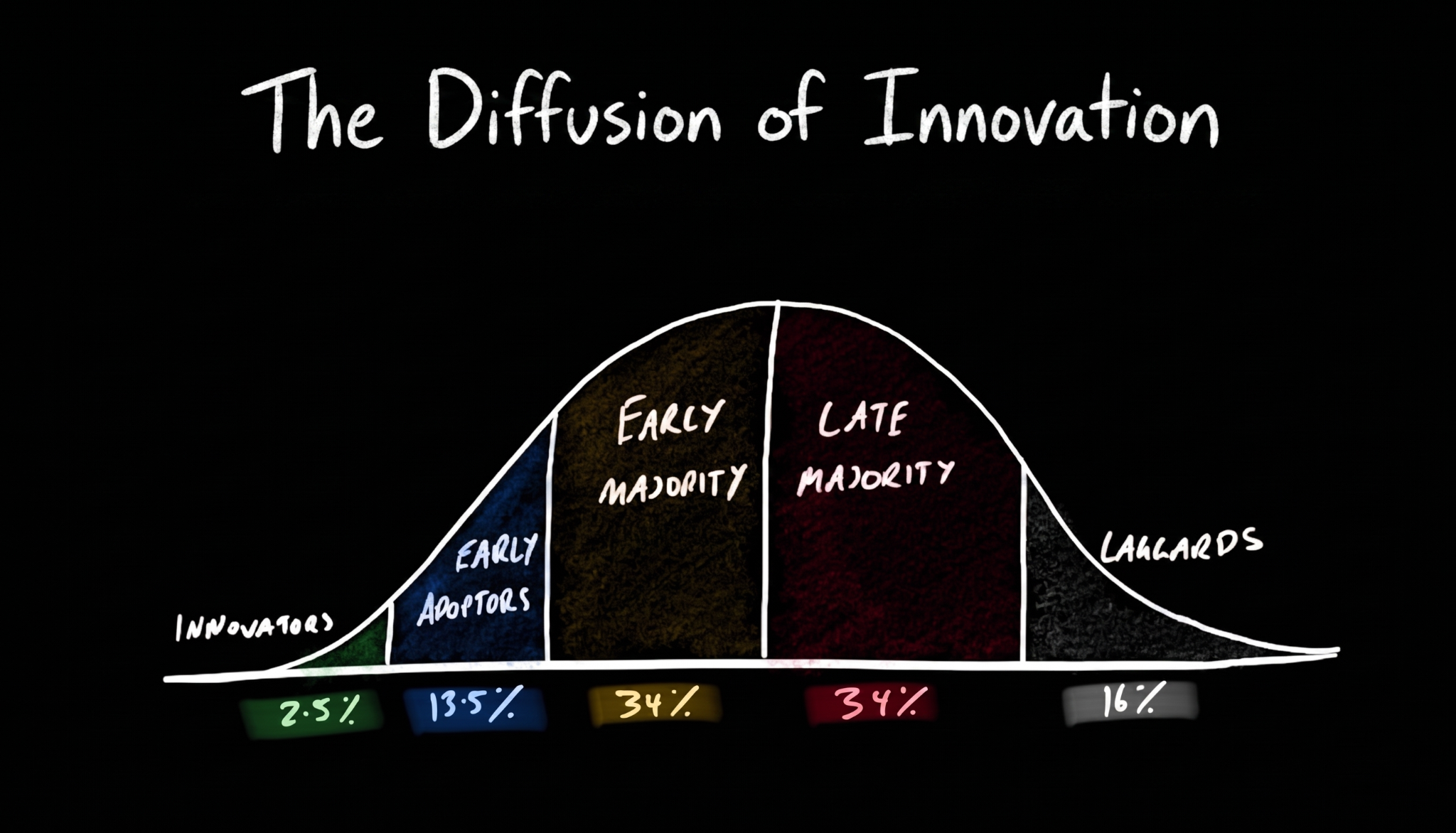
What he found was;
Innovators accounted for approximately 2.5% of the population
Early adopters 13.5%
Early majority and Late majority approx 34% each
And laggards 16%
And this curve isn’t evenly distributed.
Early adopters and innovators take up new technologies quickly.
They were the ones buying Tesla’s 10+ years ago and buying NFTs.
They were also likely the ones who put a few $$ into crypto in the early days.
But the early majority are the opposite. They take time to adopt things.
They need to see something work for a while - years even!
They want to see their colleagues, their peers, people they trust, using it successfully before they'll adopt it themselves - in other words, they’re the ones buying EVs today, not back in 2015.
It’s taken them about 10 years to come around and even still I’m sure some of you reading this aren’t convinced.
But this phenomenon is well researched. Geoffrey Moore even wrote an entire book about the challenges in making the leap from early adopters to the majority, called Crossing the Chasm.
His core insight was the gap between early adopters and the early majority is so significant it warrants being called a chasm.
And AI has even reached this stage yet.
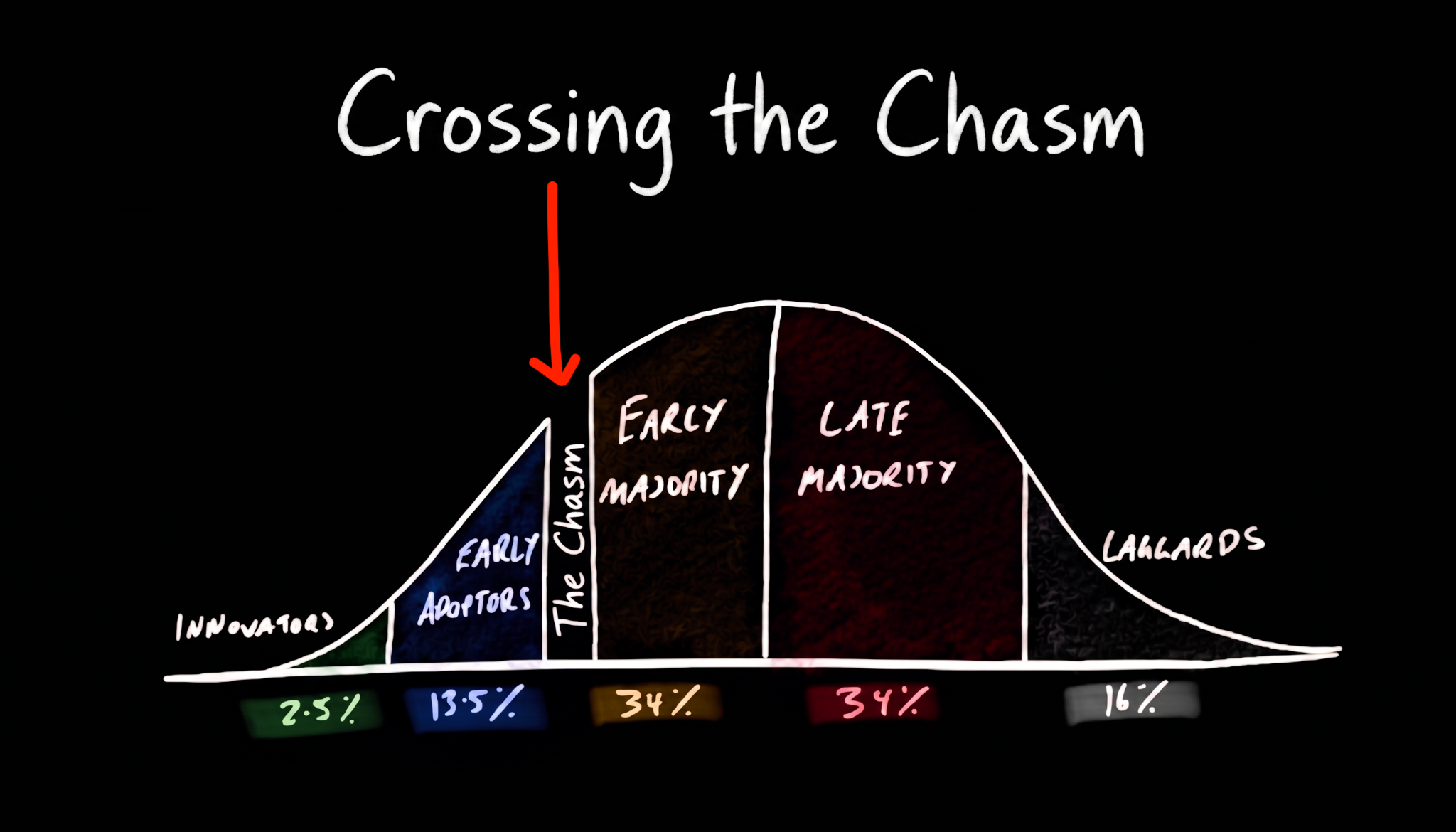
The mental model to take away here is that whilst AI adoption might look like it’s moving at lightspeed it’s only across early adopters. For the other ~84% of companies, people and product managers for that matter, they’re still yet to go beyond asking ChatGPT to draft email replies for them.
Don’t mistake the loudest voices with representing everyone.
I’ve already seen this with my clients and those in the product mentorship. One VP their company even created a separate team tasked with turning their entire product “AI first” only to find out customers didn’t want it and they’re now reverting back and winding that team up.
Company Diffusion
Clayton Christensen's The Innovator's Dilemma describes this paradox at the company level:
"The very decision-making and resource-allocation processes that are key to the success of established companies are the very processes that reject disruptive technologies.”
What he’s describing is a similar phenomena that happens at the company level - after all companies are made up of people.
Small startups often act as early adopters whilst large companies are skeptical. They often take a lot longer to invest and often need proof first.
This is a rational response to uncertainty. And it's exactly what Everett Rogers framed with the Diffusion of Innovation.
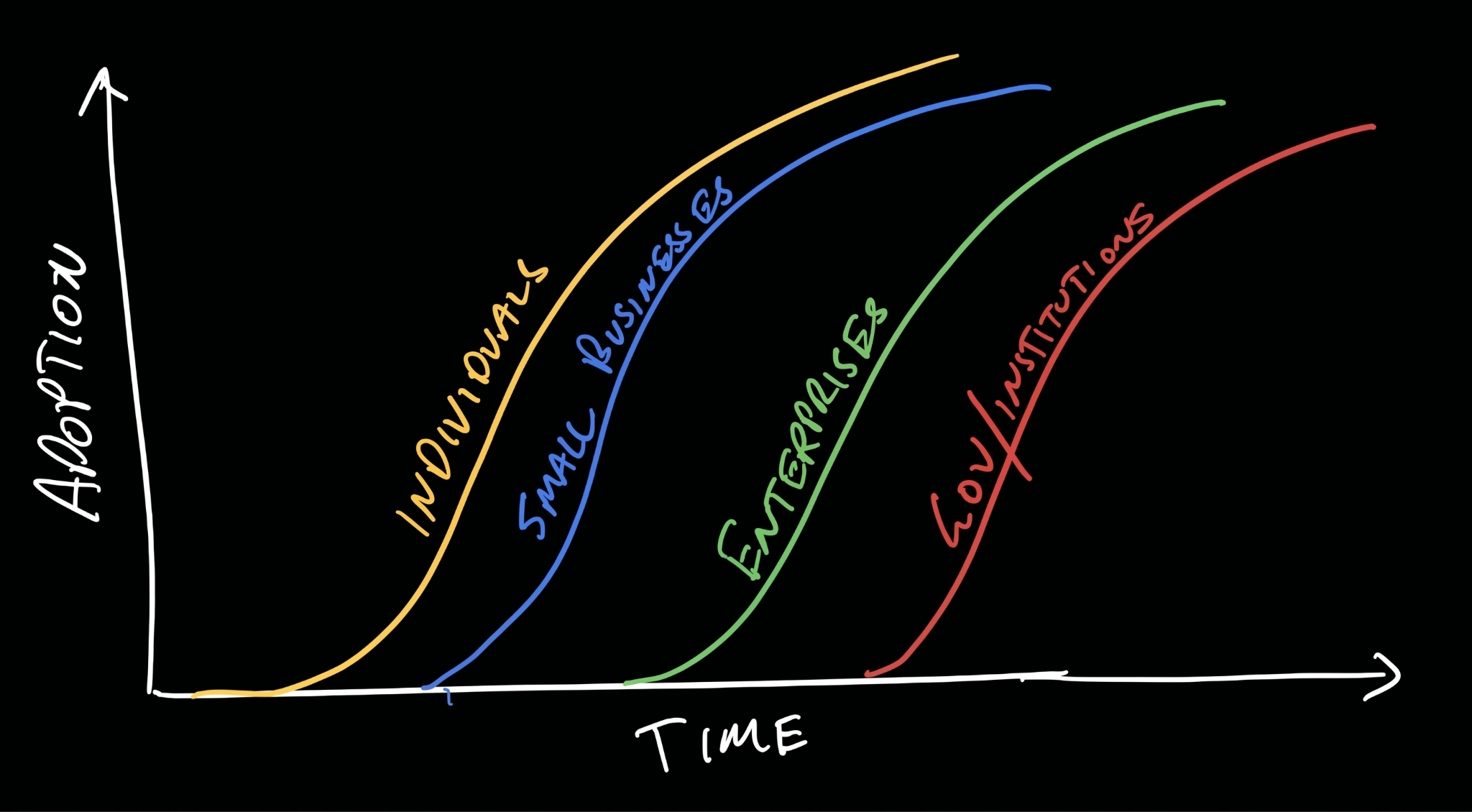
You can think of startups as innovators, scale ups as early adopters and institutions like government agencies as laggards.
The adoption across these groups often look more like this.
But AI is Different…
But AI is different in one way that actually makes adoption harder.
AI is personal.
It’s not another tool, to some it’s viewed as a replacement.
“AI attacks our identity in a way that most software doesn't” - Vikram Sreekanti
We’ve all heard the stories about people training AI models to replace them and the doomsday view that entire professions like software engineering will be completely replaced by AI.
AI is asking a lot from us emotionally right now which makes it hard to fully embrace.
We don’t like difficult things and we often have cognitive dissonance when it’s something that challenges us.
AI is doing just that. Even if it doesn’t replace our roles, it’s definitely asking us to relearn and redefine them.
As Kahneman and Tversky, the forefathers of behavioral economics and the authors of the book ‘Thinking Fast and Slow’ found, we give roughly twice the weight to losses as we do to equivalent gains.
In other words, the fear around AI will paralyse us more than any potential gain it might give us.
Reinvent Yourself First
Remember how I said that I’m seeing companies abandon and scale back their AI projects?
Well that’s not 100% true.
What I’m seeing is they’re scaling back their customer-facing AI projects.
They’re realizing everything I’ve talked about above - the diffusion of innovation and the difference between early adopters and the rest.
But there’s one space that’s less affected by this.
Or more accurately it’s a space that you have more control over.
And that’s internal use cases.
Internally you have more control.
You can change responsibilities, set expectations and even hire-and-fire.
And this is where I’m seeing my clients put their AI efforts.
The majority of teams building AI solutions that I’m working with are internal product teams. They’re creating AI products to make their back office more efficient or create tools that will help them serve customers better.
Many have even redirected their customer-facing AI efforts from 2024-2025 to internal AI products today.
I managed to dig up some public data that supports this too. Menlo Ventures found that enterprises identify slightly more internal-facing AI use cases (59%) than customer-facing ones (41%). And the largest enterprise AI spend category? Coding tools at $4 billion — overwhelmingly internal-use.
I also see this as something deeper than just an efficiency opportunity.
Change starts with you - as they say.
Shipping AI features is easy. Especially when they’re a solution looking for a problem - many learned this the last 2 years.
What’s hard is a) getting people to adopt it as I’ve covered above. But also b) reinventing yourself to the new paradigm.
Because surviving a paradigm shift like this is less about what your product does - of course that matters to an extent and might matter more to some companies than others.
Instead it’s about you adapting to the change.
Think about all the companies that failed to adapt to modern ways of working. For some that was their achilles heel. I’m sure they had a good idea of what needed to be done they just couldn’t execute on it.
“Ideas are cheap, execution is everything” afterall.
Or as I like to say;
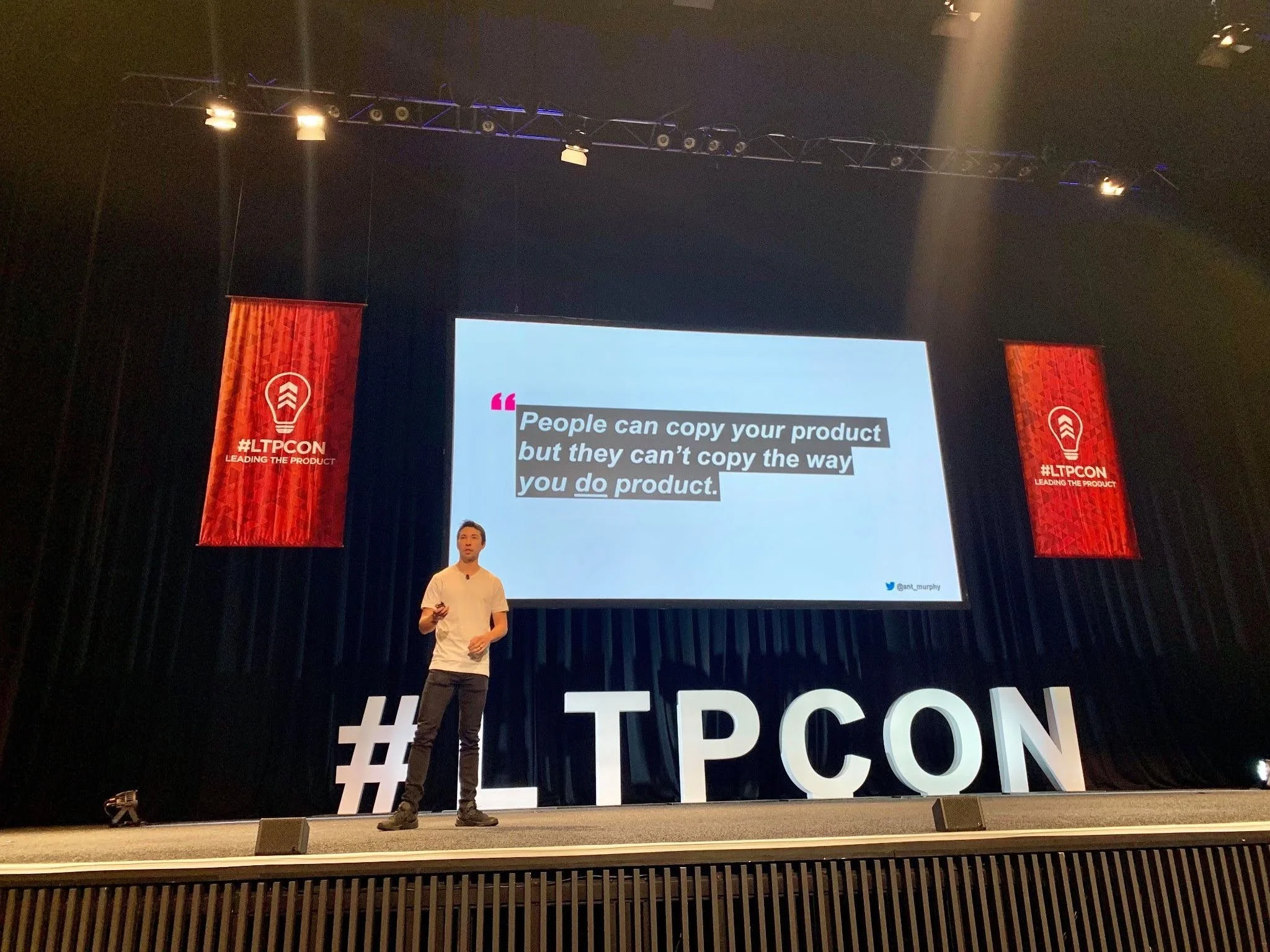
People can copy your product, they can’t copy how you do product.
FYI if you're wondering where to start with AI, I’m taking interest for running an in-person AI Build Day in Sydney in June. You'll leave with your own AI setup as the first step to reinventing yourself with AI.
No slides or theory, 100% hands on - you’ll be building it yourself with the help of experts. Interested? Register here.
Practical Insights for Product Leaders
I did a live stream the other week about how I’m seeing Product Management change in the AI era, you can watch that if you’re interested.
In regards to this, I take a few things away:
Human behaviour doesn’t change: or at least it changes much slower than AI does
The bubble is smaller than we think: The people on Linkedin, your peers who are all excited about AI agents are likely not representative of your user base - and be mindful that the early adopters are often the loudest.
The adoption curve will take longer: the Diffusion of Innovation is well studied, well researched, and it applies to AI just like it applied to cloud, mobile, and every technology before it. The early majority needs to see their peers succeeding before they'll commit.
But that doesn’t mean, do nothing and wait for AI adoption to grow.
There’s so much you can do today, so much opportunity outside of completely reinventing your organization into an AI one (note this might make sense depending on what company you have).
For the majority of us, the opportunity is internal.
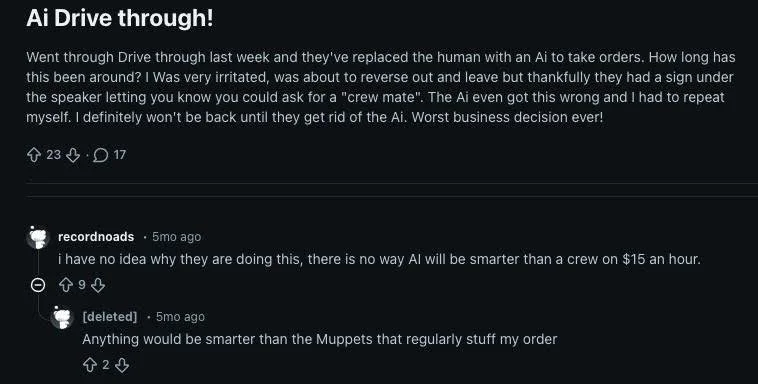
I suspect a lot of companies are learning this the hard way right now. They’ve probably fired their customer support staff and replaced them with AI only to get flooded with negative feedback.
Now don’t get me wrong, I agree a lot with where AI is heading. It’s another smart phone and the internet.
But just like those two before, the change wasn’t material right away. In fact it took several years before you looked back and realised just how much it did radically change.
The companies that survive won't be the ones that transform to an AI company tomorrow - in fact they’ll be the most vulnerable when the bubble pops.
Instead I believe it’ll be the ones that understand human behaviour, respect the adoption curve, and reinvent themselves first.
Hope that helps.
If any of it resonated, forward it to a fellow product leader who should read it.
And as always, if you have any questions - hit reply or drop a comment below I’ll be happy to answer it.
Thanks for reading!
/Ant
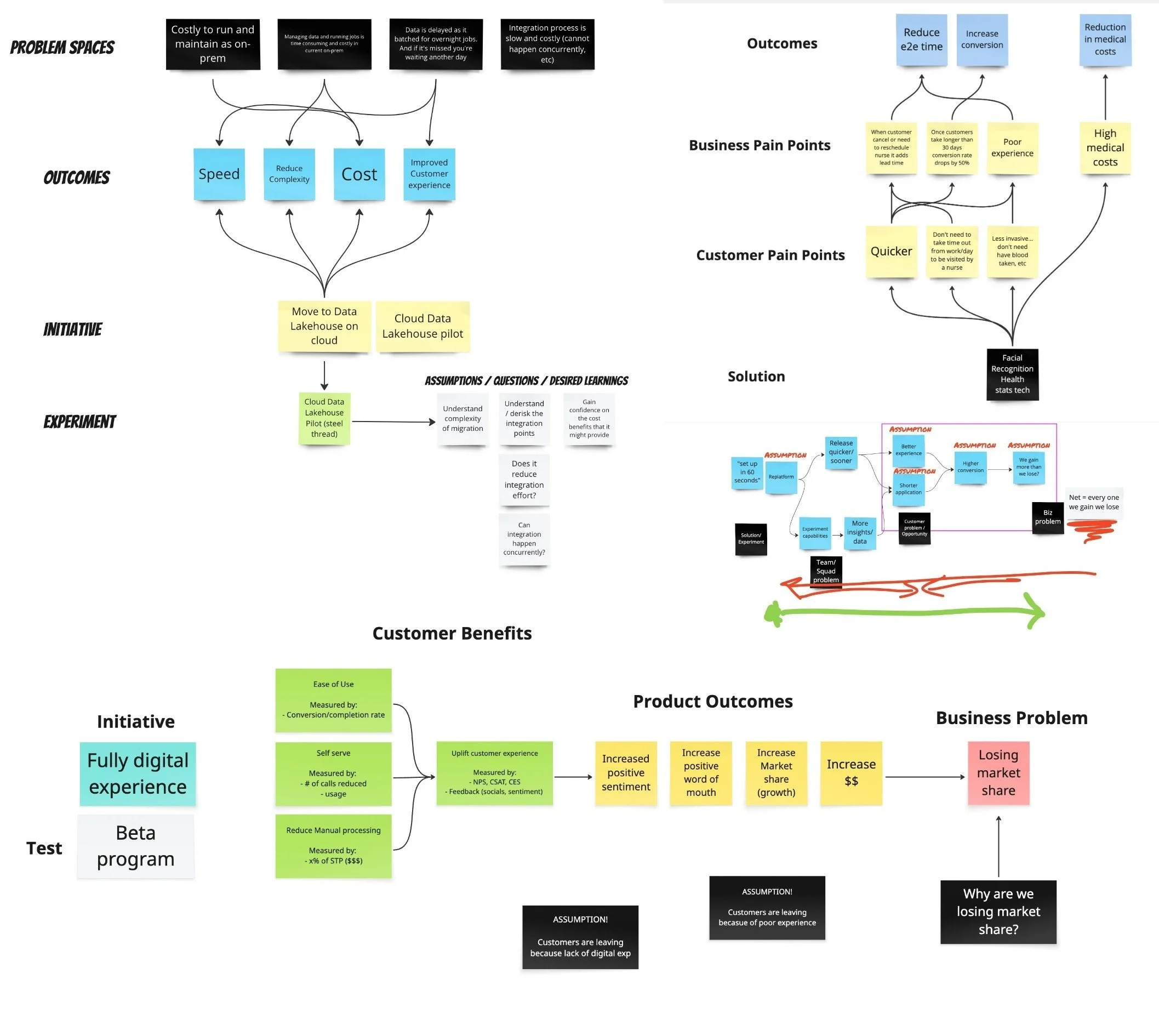







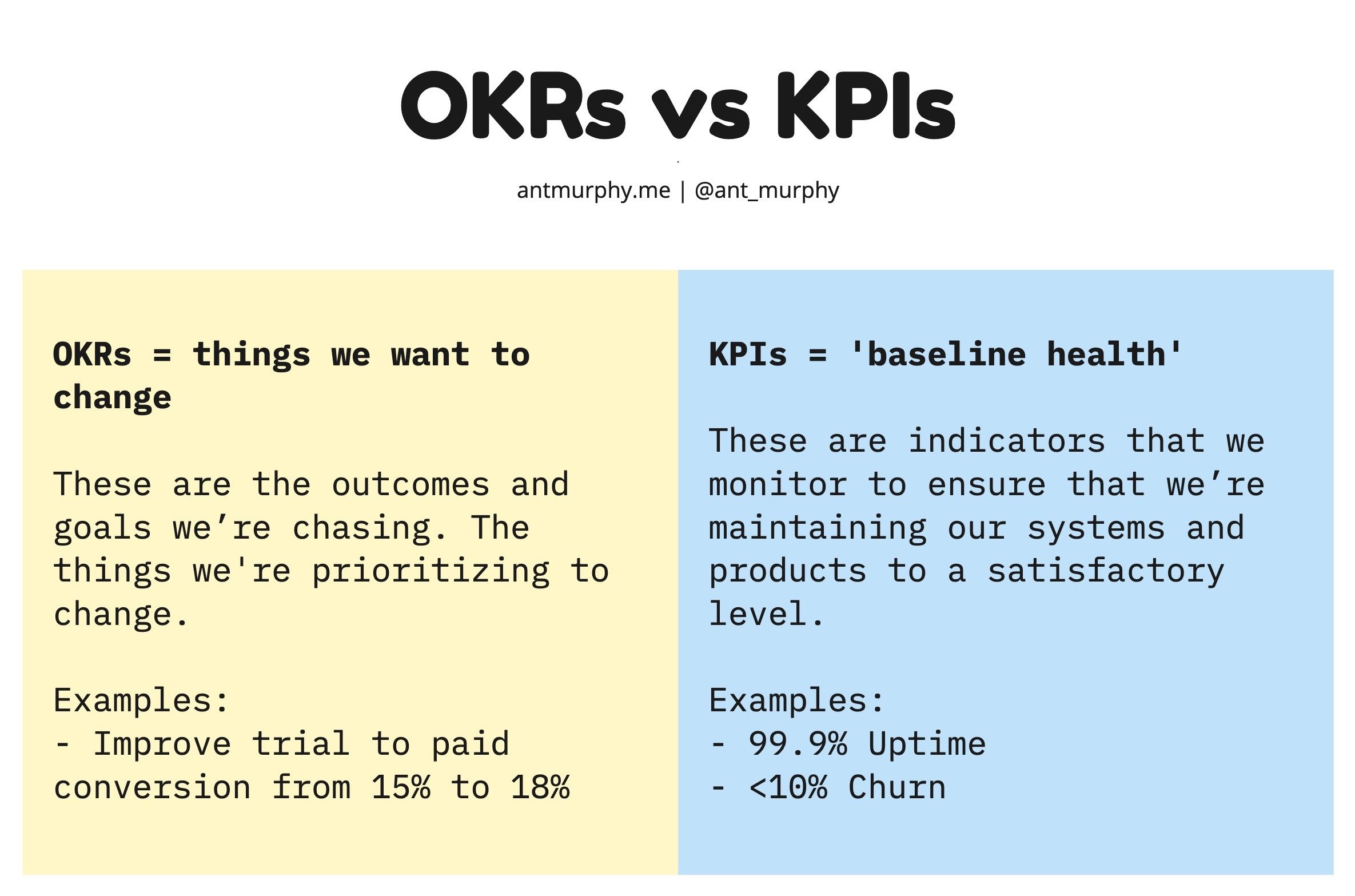

Your OKRs don’t live in a vacuum.
Yet this is exactly how I see many organizations treat their OKRs.
They jump on the bandwagon and create OKRs void of any context.
Here’s what I see all the time…